
How to Use AI for Social Media Content Creation in 2026
Discover how to leverage AI tools to streamline your social media content creation process. Learn proven strategies, workflows, and best practices for every major platform in 2026.
Quick Answer
Start with AI title and description generators for immediate results—they can boost engagement by 30-40% without changing your content creation process. Use HypeNest's free AI tools to generate optimized titles and descriptions for your videos.
For full workflow automation, combine AI editing tools, caption generators, and scheduling platforms. The key: let AI handle repetitive tasks like clipping, captioning, and formatting while you focus on creative strategy and authentic connection with your audience.
Why Use AI for Social Media Content?
The social media landscape has become increasingly competitive. Platforms like TikTok and YouTube Shorts demand consistent, high-quality content to maintain audience engagement. AI tools, like our AI video repurposing tool for YouTube & TikTok, offer a solution by automating repetitive tasks like clipping long-form videos, generating captions, and reformatting content for different aspect ratios while allowing creators to focus on strategy and creativity.
- Time Efficiency — Reduce content creation time by 60-70%. Tasks that took hours—like editing, caption writing, and thumbnail design—now take minutes with AI assistance.
- Data-Driven Insights — AI analyzes millions of successful posts to recommend what works best for your specific niche, audience, and content format.
- Consistency — Maintain a regular posting schedule without burnout or quality drops, even as you scale across multiple platforms.
- Scalability — Create content for multiple platforms simultaneously without proportional time increase. One video becomes five platform-specific cuts automatically.
The key is knowing which tools to use and how to integrate them effectively into your existing workflow without losing your unique creative voice.
Best AI Tools for Content Creators
The AI content creation landscape offers various tools, each excelling at specific tasks. Here's a breakdown of the most effective categories for social media content creators in 2026:
1. AI Video Title & Description Generators
These tools help you craft click-worthy titles and SEO-optimized descriptions that drive views and engagement. They analyze trending patterns in your niche and suggest high-performing keyword combinations tailored to your content.
Recommended: HypeNest
- Free AI title generator with engagement scoring (0-100 scale)
- SEO-optimized description writer with keyword suggestions
- Platform-specific optimization (YouTube, TikTok, Instagram, LinkedIn)
- Bulk generation for content planning and batch scheduling
2. AI Video Editing Tools
Automated editing tools that can cut, trim, add captions, and optimize videos for different platforms in a fraction of the time manual editing would take:
- Auto-captioning: — Tools that generate accurate subtitles automatically with customizable styling and positioning
- Smart clipping: — AI identifies the best moments from long-form content and creates shareable short clips
- Format optimization: — Automatic resizing and formatting for each platform's preferred aspect ratio (9:16, 16:9, 1:1)
- B-roll insertion: — AI suggests and adds relevant supplementary footage from your library or stock sources to keep viewers engaged
Also see: How to write video descriptions that boost SEO for tips on optimizing your video metadata and discovery.
3. AI Content Planning Tools
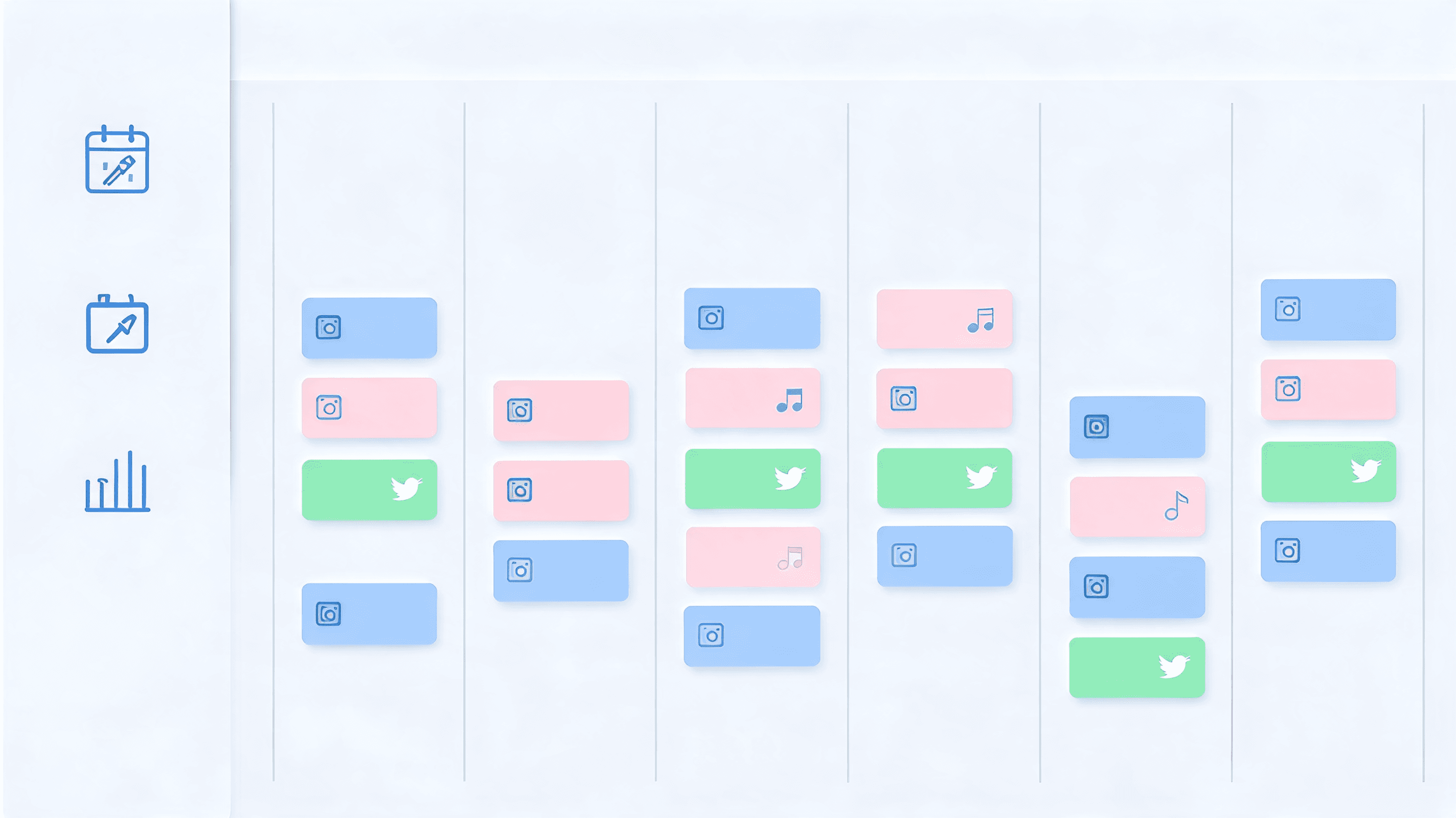
Strategic tools that help plan your content calendar using AI insights and audience behavior analysis:
- Trend prediction: — Identifies emerging topics before they peak so you can create timely, relevant content
- Content gap analysis: — Finds opportunities competitors are missing in your niche and suggests underserved topics
- Posting schedule optimization: — Recommends best times based on your audience's activity patterns across time zones
- Niche-specific suggestions: — Tailored content ideas and formats proven to perform well in your specific vertical
Creating Your AI-Powered Workflow
The most effective approach combines AI automation with human creativity. Here's a proven workflow that successful creators use to maximize output while maintaining quality and authenticity:
The 5-Step AI Content Workflow
- Research & Planning (20% AI, 80% Human) — Use AI trend tools to identify topics and keywords, but apply your unique perspective and expertise to shape the final concept. AI suggests, you decide on direction and messaging.
- Content Creation (50% AI, 50% Human) — Create your core content (video, image, text). Use AI for initial drafts or templates, then customize with your voice, brand identity, and personal storytelling style.
- Optimization (80% AI, 20% Human) — Use AI to generate titles, descriptions, hashtags, and captions. Generate 5-10 options and choose the best match. This is where AI truly excels—turning good content into discoverable content.
- Editing & Formatting (70% AI, 30% Human) — Let AI handle technical editing: captions, cuts, transitions, resizing, and color correction. You add final touches, verify pacing, and ensure brand consistency across all outputs.
- Publishing & Analysis (60% AI, 40% Human) — Use AI for automated scheduling, cross-platform posting, and initial analytics aggregation. You interpret the results, spot trends, and adjust your content strategy based on real data.
Example: Creating a TikTok Video with AI
Scenario: Fitness creator making a workout tutorial from start to finish
- Day 1 - Planning: — AI trend tool suggests '5-minute morning routines' is spiking in your niche. You decide to create '5-Minute Energy Boost Workout' with your personal twist.
- Day 1 - Filming: — Record your workout routine (15 minutes of raw footage). This is all you—your energy, your personality, your expertise. AI doesn't help here.
- Day 2 - Editing: — AI video editor adds auto-captions with 99% accuracy, cuts dead space between exercises, and suggests the top 60 seconds of content automatically (30 minutes saved vs manual editing).
- Day 2 - Optimization: — Use HypeNest to generate 10 title options with engagement scores. Pick '5-Min Energy Boost (No Equipment Needed!)' Score: 89/100. Highest predicted CTR in your niche.
- Day 2 - Description: — AI generates SEO-optimized description with trending hashtags: #morningworkout #quickfitness #energyboost. Includes timestamps for each exercise and a CTA to follow for more.
- Day 2 - Publishing: — AI scheduler automatically posts at optimal time (6:30 AM when your audience of early risers is most active and engagement rates peak).
- Day 3 - Analysis: — AI analytics dashboard shows video is performing 40% better than your usual average. Suggests creating more 'quick routine' content and identifies the exact moment where viewer drop-off occurs.
Result: — Total time invested: 2 hours (vs 5+ hours manually). Engagement: +45% compared to non-AI-assisted videos. You published 3x more content that week without burning out.
Best Practices for AI Content
To maximize the benefits of AI while maintaining authenticity and trust with your audience, follow these proven best practices used by top creators:
1. Maintain Your Unique Voice
AI should enhance your content, not replace your personality. Always add your personal touch and lived experiences to what AI generates:
- Edit AI-generated text to match your natural speaking style and cadence
- Add personal anecdotes, stories, and experiences that only you can share
- Use AI as a starting point or brainstorming partner, not the final product
2. Quality Over Quantity
Just because you can create content faster doesn't mean you should sacrifice quality. Use the time AI saves to polish your work:
- Use saved time to improve content quality, not just increase publishing volume
- Set clear quality standards that every AI output must meet before publishing
- A/B test AI-generated suggestions against your own to find the optimal mix
3. Stay Transparent
Audiences appreciate honesty about AI usage when it's communicated authentically:
- Disclose when content is AI-assisted if the AI contribution is significant
- Share your AI workflow with your audience—they find the process interesting
- Focus messaging on how AI helps you create better, more frequent content for them
Important — Always fact-check AI-generated content, especially statistics, dates, quotes, and factual claims. AI can occasionally produce plausible-sounding but inaccurate information that could damage your credibility.
Common Mistakes to Avoid
Learning from others' mistakes can save you time, reputation, and credibility. Here are the most common AI content pitfalls and how to avoid each one:
Publishing AI Content Without Review
The Mistake: — Copy-pasting AI outputs directly without reading or editing the text first.
The Fix: — Always review, edit, and add your personal touch before publishing. Create a pre-publish checklist that includes fact-checking, tone adjustment, and brand voice alignment.
Using Generic Prompts
The Mistake: — Asking AI to 'write a video description' without providing any context about your content.
The Fix: — Provide detailed prompts with your niche, target audience, desired tone, key talking points, and platform. Specific prompts produce specific, usable results every time.
Ignoring Platform-Specific Requirements
The Mistake: — Using the exact same AI-generated content across all platforms without customization.
The Fix: — Customize content for each platform's unique format and audience expectations. TikTok needs hooks in the first 3 seconds, YouTube needs longer context and SEO keywords, LinkedIn needs professional tone.
Over-Relying on AI for Creative Decisions
The Mistake: — Letting AI make all content strategy decisions without human judgment or audience intuition.
The Fix: — Use AI for data-backed suggestions and inspiration, but trust your instincts and deep understanding of your audience when making final creative and strategic decisions.
Measuring AI Content Success
To ensure your AI integration is delivering real results, track these key metrics across efficiency and performance categories:
Efficiency Metrics
- Time saved per content piece: — Track hours before vs after AI implementation for accurate ROI calculation
- Content output volume: — How many pieces of content can you create and publish weekly with AI assistance?
- Cost per content piece: — Factor in AI tool subscriptions vs time saved to calculate your true cost efficiency
Performance Metrics
- Engagement rate: — Compare AI-assisted content vs non-AI content to validate the approach
- Click-through rate: — Are AI-generated titles and thumbnails driving higher click-through rates?
- View duration: — Does AI-optimized editing and pacing improve average watch time and retention?
- Conversion rate: — If you're selling products or services, does AI-generated content convert better?
Example Success Dashboard
| Metric | Before AI | After AI | Change |
|---|---|---|---|
| Time per video | 4.5 hours | 1.8 hours | -60% |
| Videos per week | 3 | 7 | +133% |
| Avg. engagement | 4.2% | 6.1% | +45% |
| CTR on titles | 8.5% | 11.8% | +39% |

Frequently Asked Questions
Can AI completely replace human content creators?
No. AI is a powerful assistant but not a replacement for human creativity, emotion, and lived experience. The most successful creators use AI to handle repetitive tasks like editing, caption writing, and title generation, while focusing their creative energy on strategy, authentic connection with their audience, and unique perspectives that no AI can replicate.
How much time can AI save in content creation?
Creators typically save 60-70% of their production time using AI tools. Tasks that used to take hours—editing raw footage, writing multiple descriptions, creating thumbnails, scheduling posts—now take minutes. This time savings allows you to create more content or reinvest those hours into higher-value activities like community engagement and strategic planning.
Do I need technical skills to use AI content tools?
No. Modern AI content tools like HypeNest are specifically designed for creators without technical backgrounds. Most tools feature simple upload-and-generate interfaces with drag-and-drop functionality. You don't need coding skills, machine learning expertise, or any technical background—just upload your raw content and the AI handles the rest automatically.
Will using AI hurt my content's authenticity?
Only if you rely on AI completely without adding your personal touch. Use AI for technical tasks (editing, SEO, formatting, captioning) and optimization suggestions, but always customize outputs to match your unique voice and add your personal perspective. Think of AI as a smart assistant that handles busywork, not a ghost writer who creates your content.
What's the best AI tool for social media content?
It depends on your specific needs and content type. For video content creators, HypeNest offers an all-in-one solution: automatic clipping from long-form content, AI title generation with engagement scoring, description writing with SEO optimization, and thumbnail creation. For pure caption writing, several AI writing tools work well. Start with free tiers to test what works best for your specific content format and creative workflow before committing to a paid plan.
AI Content Creation for Different Niches
Not all content niches benefit from AI in the same way. The most effective AI strategies are tailored to your specific vertical, audience expectations, and content format. Whether you create gaming videos, fitness guides, educational tutorials, or financial content, there are AI-specific approaches that will dramatically improve your output quality and efficiency.
Gaming
Gaming creators face the challenge of capturing peak moments from hours of footage. AI excels here: use smart clipping tools to automatically identify highlights, clutch plays, and funny moments from long sessions. AI title generators analyze trending gaming keywords and craft click-worthy titles that match platform search behavior. Thumbnail AI tools detect the highest-energy frames from your gameplay for maximum visual impact.
Fitness & Wellness
Fitness creators benefit enormously from AI-driven content repurposing. A single 30-minute workout video can become 8–12 short-form clips targeting different muscle groups or intensity levels. AI description writers understand fitness search intent and naturally include terms like 'beginner workout,' 'no equipment needed,' and 'home fitness,' boosting organic discovery. AI scheduling tools identify when your specific fitness audience is most active—typically early morning or after-work hours.
Education & Tutorials
Educational creators face the dual challenge of being informative and engaging. AI tools help structure content for maximum comprehension: auto-generated timestamps let viewers navigate to specific lessons, AI chapter markers improve YouTube SEO, and description generators craft keyword-rich summaries that answer the exact questions students are searching. AI translation tools also help educational content reach international audiences without significant extra effort.
Finance & Business
Finance creators operate in a high-trust environment where accuracy and professionalism matter above all. Use AI to generate clear, jargon-appropriate titles that speak directly to investor or entrepreneurial intent. AI compliance-checking tools can flag potentially misleading claims before publishing. Always combine AI efficiency with thorough human review to maintain the credibility that finance audiences demand.
Building Your AI Content Stack in 2026
No single AI tool does everything well. The most successful creators in 2026 operate with a curated stack of complementary tools, each handling a specific stage of the content production pipeline. The key is integration—your tools should pass data and outputs between each other smoothly, minimizing manual handoffs. Start with two or three essential tools and expand only when you have clearly identified a bottleneck that a new tool can solve. Avoid tool overload, which creates complexity without proportional benefit.
The average creator spends $50–$150 per month on their AI content stack. When you factor in time saved—typically 8–15 hours per week—the ROI is substantial even at premium price points. A single additional monetizable video or brand deal per month will easily cover your entire stack cost, making AI tools one of the highest-leverage investments a creator can make.
The Recommended Stack
- Title & Description Generation: HypeNest — AI-powered titles, descriptions, and SEO metadata with engagement scoring and platform-specific optimization
- Video Editing & Clipping: CapCut or Descript — Auto-captions, smart clip detection, background noise removal, and multi-format export in one workflow
- Scheduling & Publishing: Buffer or Later — AI-driven optimal posting times, cross-platform scheduling, and first-comment hashtag automation
- Analytics & Insights: TubeBuddy or VidIQ — Competitor tracking, keyword research, A/B thumbnail testing, and trend alerts for your niche
Calculating Your ROI
To justify your AI tool spend, calculate time saved multiplied by your hourly value. If your stack saves 10 hours per week and your creative time is worth $50/hour, that is $500 in weekly value—far exceeding a $150/month tool investment. Track your content output volume before and after AI adoption, your engagement rate changes, and any revenue increases tied to higher posting frequency to build a concrete ROI case for scaling up.
Advanced Prompt Engineering for Better AI Outputs
The single biggest factor determining the quality of AI-generated content is not the tool you use—it is the quality of your prompt. Most creators dramatically underutilize AI by submitting vague, context-free requests and then dismissing the generic outputs as 'not good enough.' With the right prompting framework, the same AI tool that produces mediocre results for one creator can generate publication-ready content for another. Learning to write high-quality prompts is the most impactful AI skill a content creator can develop in 2026.
The High-Performance Prompt Formula
Every high-performance prompt contains five key elements: Role (tell the AI who it is), Context (describe your niche, audience, and platform), Task (specify exactly what you need), Constraints (define length, tone, format, and exclusions), and Examples (show the AI what good looks like). Prompts that include all five elements consistently produce outputs requiring minimal editing that match your brand voice with high fidelity.
Before and After: Prompt Improvement
Before:
Write a YouTube description for my fitness video about morning workouts.
After:
You are a YouTube SEO expert. Write a 150-word description for a 10-minute beginner morning workout video targeting 25–40 year old office workers. Include keywords 'morning workout at home,' 'no equipment,' and 'energy boost.' Use an encouraging, upbeat tone. End with a CTA to subscribe.
- Always specify your target audience by age, profession, or interest level—generic prompts produce generic results
- Include your brand voice adjectives (energetic, authoritative, conversational) to keep AI outputs consistent with your content identity
- Request multiple variations (ask for 5 title options, not just 1) to give yourself meaningful choices and A/B test material
- Save your best-performing prompts as templates in a personal library and refine them over time as you learn what works for your niche
Ready to Supercharge Your Content with AI?
Start with our free AI tools and see immediate results. Generate optimized titles and descriptions in seconds—no credit card required, no commitment. Or try HypeNest for the complete video automation platform with clipping, captioning, and scheduling built in.
Platform-Specific AI Content Strategies
Each social media platform has unique requirements, audience behaviors, and algorithm preferences. Your AI strategy should adapt accordingly to maximize reach and engagement on every channel.
YouTube (Long-Form and Shorts)
YouTube rewards depth, searchability, and watch time above all else. Use AI to generate SEO-optimized titles with high-volume keywords, write detailed descriptions with timestamps for each section, suggest chapter markers automatically, create thumbnail concepts based on top-performing templates, and draft community posts that drive discussion and repeat engagement.
TikTok
TikTok rewards hooks, authenticity, and retention in the first few seconds. Use AI to generate hook-driven captions that grab attention immediately, suggest trending audio tracks and hashtag combinations that match your niche, and create multiple script variations for A/B testing different opening angles and storytelling approaches.
Instagram Reels
Instagram Reels sit between TikTok's casual energy and YouTube's production quality. Use AI to generate captions that work effectively as both Reels descriptions and feed posts, suggest trending Reels audio, and optimize your visual hierarchy for mobile-first consumption with text overlays and eye-catching patterns.
LinkedIn Video
LinkedIn video is a rapidly growing opportunity with significantly less competition than other platforms. Use AI to generate professional, insight-driven descriptions that position you as a thought leader, craft hooks that speak to business professionals and decision-makers, and format your content for a desktop-first viewing experience with clear talking points and data visualizations.
Scaling Your Content Production with AI
The real power of AI content tools is not just saving time on individual pieces. It is the ability to scale your content production to levels that would be impossible manually, opening up new growth opportunities across multiple platforms simultaneously.
Level 1: Solo Creator (3-5 posts per week)
At this level, your goal is consistency without burnout. Record one long-form video per week (15-30 minutes), use HypeNest to automatically generate 5-8 short clips optimized for different platforms, and rely on AI for titles, descriptions, and hashtags. Total weekly time investment: 3-4 hours of creative work.
Level 2: Growing Creator (1-2 posts per day)
At this level, record 2-3 long-form videos per week (30-45 minutes each), generate 15-20 platform-optimized short clips, and create tailored titles and descriptions for each platform. Use AI analytics to identify your top-performing content types and double down on what works. Total weekly time: 6-8 hours including strategy and engagement.
Level 3: Content Team (3-5 posts per day across multiple channels)
At this level, batch-process all content simultaneously using standardized AI workflows and templates. Generate 30-50 clips per week from your long-form content with automated metadata, descriptions, and scheduling. Total weekly time: 12-15 hours for a team of 2-3 people working with efficient AI pipelines and review processes.
Ethical AI Use in Content Creation
As AI becomes more powerful and prevalent in content creation, ethical considerations become increasingly important for maintaining trust with your audience and complying with platform guidelines.
Maintain Authenticity and Trust
Your audience follows you for your unique perspective, personality, and expertise—not for generic AI-generated content. Always review, personalize, and add your voice to AI outputs before publishing. Transparency about your AI workflow actually builds deeper trust with viewers who appreciate the honesty.
Ensure Accuracy and Fact-Checking
AI can generate plausible-sounding information that is completely factually incorrect—a phenomenon known as hallucination. Always verify statistics, dates, quotes, claims, and technical information against reliable sources before publishing anything AI-assisted.
Respect Copyright and Attribution
Be mindful of copyright when using AI tools. Do not use AI to recreate, closely imitate, or repurpose copyrighted content owned by others. Respect intellectual property and give proper attribution when AI tools reference or build upon existing work.
Prioritize Audience Value Over AI Convenience
The ultimate test of any AI-assisted content is whether it provides genuine value to your audience. Quality should never decrease as a result of AI adoption. If AI makes your content faster but less valuable, you are using it wrong. Always prioritize what serves your audience best.
The Future of AI in Social Media Content Creation
AI content tools are evolving at an unprecedented pace. Here are the key trends that will shape content creation in the coming years and how you can prepare for them today.
Real-Time Content Optimization
AI tools will increasingly analyze content performance in real-time—within the first hour of publishing—and automatically suggest or apply adjustments to titles, thumbnails, captions, and posting times based on early engagement data and audience response patterns.
Personalized Content Variations
AI will enable creators to automatically generate multiple distinct versions of the same core content, each tailored to different audience segments, platforms, and even individual viewer preferences—all from a single source recording.
Predictive Content Strategy
AI tools will predict which topics, formats, styles, and posting schedules are likely to perform well weeks or even months in advance, allowing creators to plan their content calendars around data-driven forecasts rather than guesswork.
Automated Multi-Platform Publishing Orchestration
AI will manage the entire publishing process end-to-end: automatically generating content from source footage, optimizing the output for each platform's unique requirements, scheduling at optimal times per audience, monitoring cross-platform performance, and repurposing top-performing clips into new content without any manual intervention.