
TikTok Hooks & Retention: How Openings Drive Watch Time (2026)
Answer-first guide to TikTok hooks and retention: what platforms say about recommendations, how to define micro-retention, 7 hook frameworks with scripts, and a free clip workflow — without viral guarantees.
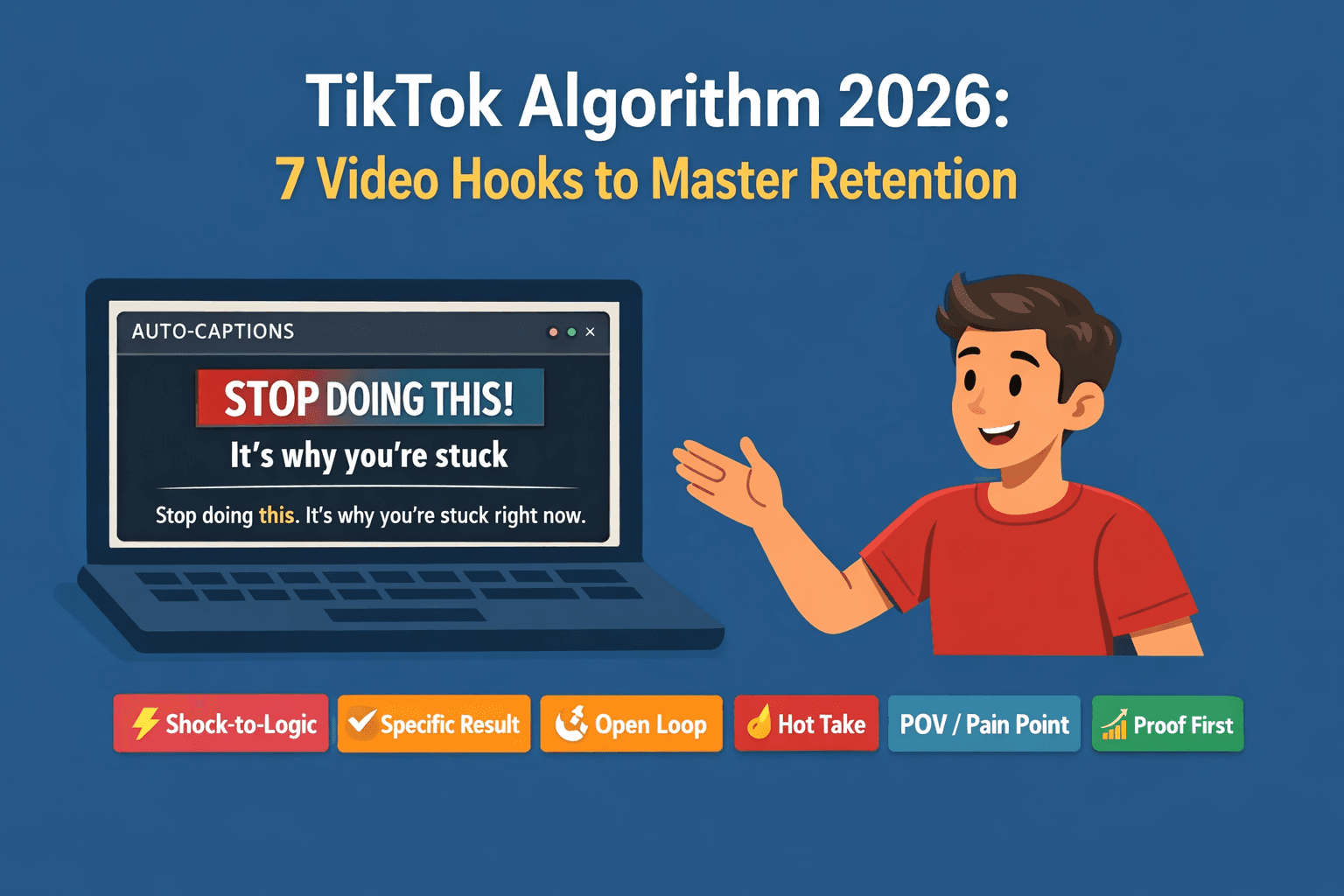
Quick answer: TikTok hooks matter because retention starts in the first seconds. TikTok's public documentation describes recommendations as predictions of interest based on content and user interactions (see TikTok's newsroom / support materials on how the For You feed ranks content). A strong hook is a clear visual + verbal promise that earns the next few seconds of watch time — not a guaranteed path to virality.
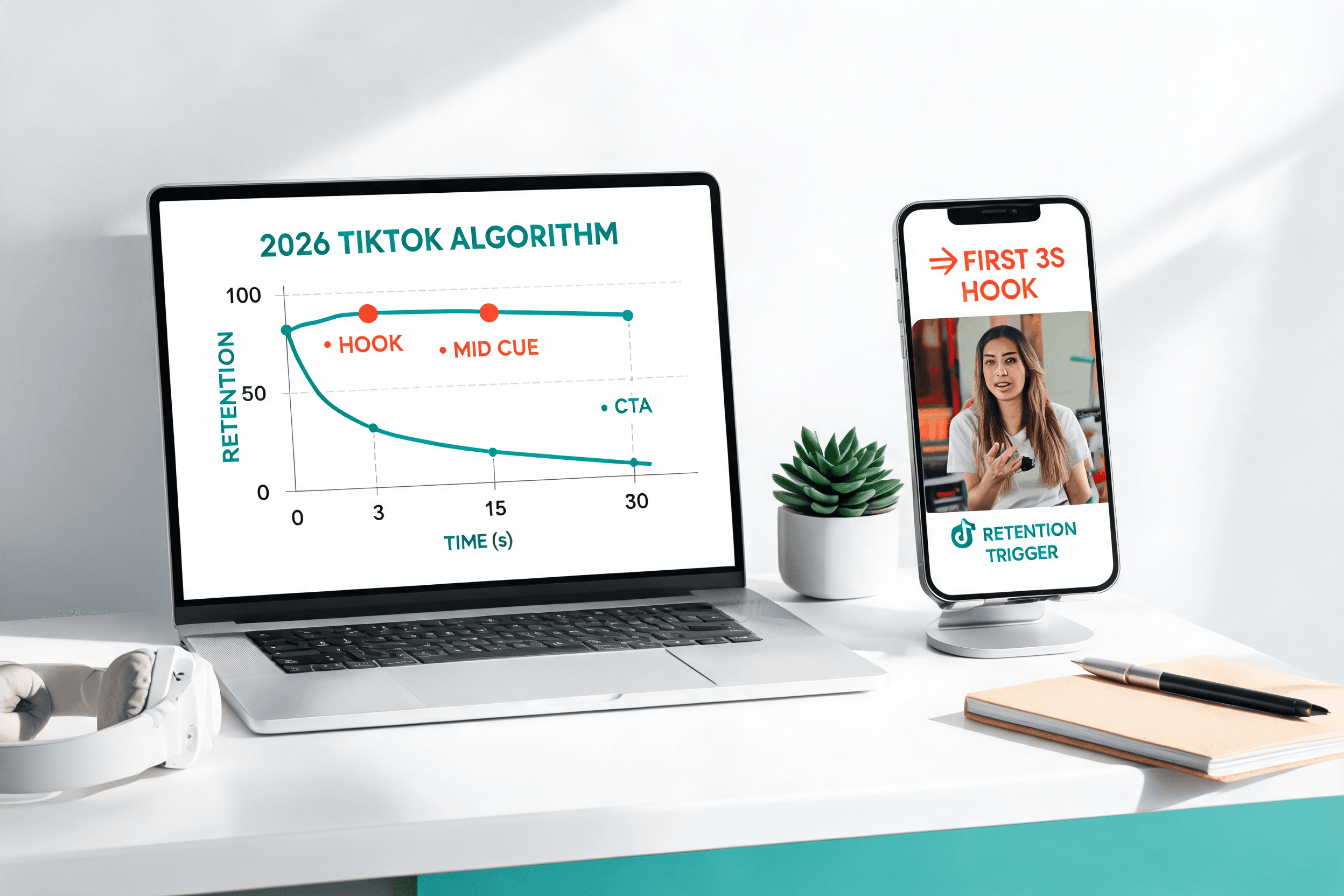
Definitions used in this guide: retention = share of viewers who keep watching at each second; micro-retention = the early checkpoints (about 1s, 3s, mid-clip, end) where most short-form drop-off happens. Official sources explain interest prediction at a high level; exact weight of completion rate, rewatches, or shares is not fully public, so treat platform docs as the source of truth and your analytics as the test bed. We do not claim a universal threshold (for example “X% completion = viral”).
Below: seven hook frameworks with scripts, visual trigger rules, how to read a retention curve, and a practical workflow to pull scroll-stopping moments from long videos (including HypeNest’s free AI clip generator). Every number or tactic that is not from an official source is labeled as observed practice or hypothesis.
What Changed in TikTok Algorithm 2026
From Views to Micro-retention
Hypothesis based on creator analytics patterns (not an official TikTok sample-size rule): short-form systems often expand distribution when early viewers stay, finish, or rewatch, and slow down when they swipe away quickly. Exact initial cohort sizes (for example “200–500 people”) are not published as a fixed global rule — use your own analytics instead of treating any third-party number as gospel.
That's why 2026 feels harsher: TikTok doesn't just "count views." It weighs behavior inside the view. Two videos can have the same view count but wildly different reach if one retains viewers and the other doesn't. Here's the idea of micro-retention in plain terms: you need to earn attention at four specific checkpoints — not just once at the beginning, but continuously throughout the video. Each checkpoint is a gate the algorithm tracks independently.
- 1s — 1-second hold: Did the viewer stay past the first beat, or did they instantly swipe? This is decided entirely by your very first frame — what they see before they even hear you speak. Movement, contrast, and facial expressions matter most here.
- 3s — 3-second decision: Did they commit to the premise, or bail once they understood the topic? By this point they should know exactly what this video is about and why they should keep watching. If your hook is unclear, viewers will leave at exactly the 3-second mark.
- Mid — Midpoint dips: Where do people start leaving? This tells you if your content delivery matches the promise your hook made. If retention drops sharply at a specific timestamp, that segment needs a pacing change, a visual cut, or more value density to keep viewers engaged.
- End — End behavior: Did they finish, rewatch, or share? Hypothesis (not an official TikTok ranking weight): strong end retention and rewatches often correlate with better distribution in creator analytics, but platforms do not publish a single “strongest signal for virality.” Treat completion and rewatch as useful diagnostics, not a guarantee that the feed will expand.
This matches how modern short-form systems learn in real time from viewing habits — especially where viewers lose interest or rewatch specific segments. TikTok's algorithm is constantly updating its understanding of what keeps people watching within each niche and subculture on the platform, which means retention patterns vary by topic and audience.
How TikTok Learns Your Audience
TikTok describes its recommender systems as selecting eligible content, then ranking it based on predictions of interest — also influenced by people with similar interests. This means your video competes in a specific interest graph, not against all videos on the platform. The algorithm first identifies which niche your content belongs to (based on keywords, hashtags, captions, and visual signals), then serves it to users who have shown affinity for that niche. Your hook is the primary signal the algorithm uses to make this classification, so if your opening is confusing or mismatched to your actual topic, the algorithm may route your video to the wrong audience entirely, tanking your retention from the start.
So your hook has two jobs at once:
- Stop the scroll — (retention)
- Set the right context — (so the algorithm finds the right viewers)
If your opening is confusing, you may still get "views," but from the wrong audience — then micro-retention drops, and distribution cools off. This is the most common trap creators fall into: they get lots of initial views from curious swipers, but because those viewers aren't actually interested in the topic, engagement metrics tank and the algorithm stops pushing the video. A clear hook doesn't just stop the scroll — it signals to the algorithm exactly who should watch, ensuring your test pool is well-targeted.
How to Break Scrolling in 2026
The Hook Stack (Visual + Verbal + Context)
The fastest way to create a hook that "breaks scrolling" is to stack 3 layers immediately, each one reinforcing the next within the first 3 seconds of your video:
Visual trigger (0.0–0.5s) — Movement, surprising frame, bold text, proof screenshot, dramatic before/after. The visual has to register before the brain even processes audio, so it must communicate something compelling purely through imagery — no sound required.
Verbal trigger (0.5–1.5s) — One clear sentence that makes a promise, creates curiosity, or states a problem. No rambling, no filler words, no throat-clearing — land the hook verbally within one second of speaking or you've already lost half your audience.
Context lock (1.5–3.0s) — Who this is for + what they'll get. By the 3-second mark, the viewer should know exactly what niche this belongs to and whether the video is relevant to them. This is where you either lock in their attention or give them a reason to leave.
Common Hook Mistakes That Kill Retention
These are silent retention killers in 2026 that creators often overlook because they seem harmless or familiar:
- "Hey guys…" — intros (no value, no tension — wastes the most critical milliseconds of your entire video)
- Generic promises — ("This will change your life") — viewers have heard it a thousand times and immediately dismiss it as clickbait
- Slow setup — (explaining background before the payoff — always deliver the hook first and provide context after you've earned their attention)
- No on-screen text — (many viewers watch without sound at first, especially on public transport, at work, or in quiet environments)
The Scaling Secret: Let AI Find the Hooks for You
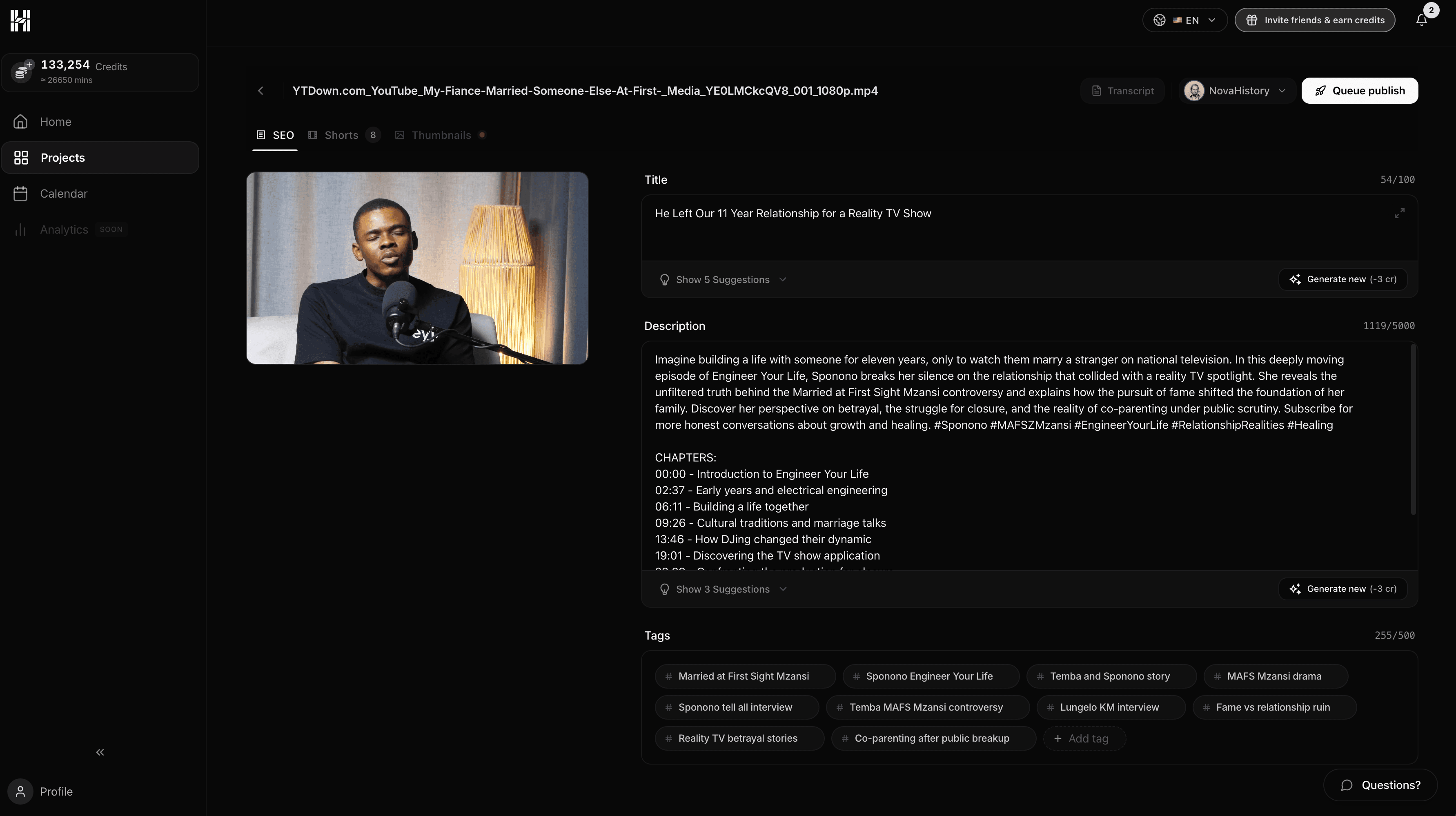
Tool CTA (product fact): use HypeNest’s free AI clip generator to pull short vertical moments with captions from a long source video, then review every clip before publish. Direct publish is live for YouTube and TikTok. This speeds packaging — it does not guarantee virality or a fixed view count.
Practical workflow: (1) record or upload a long video, (2) generate clip candidates, (3) pick openings that match one of the seven hook frameworks below, (4) add on-screen text, (5) check your retention graph after publish and iterate. Official platform guidance + your analytics beat generic “viral hooks” lists.
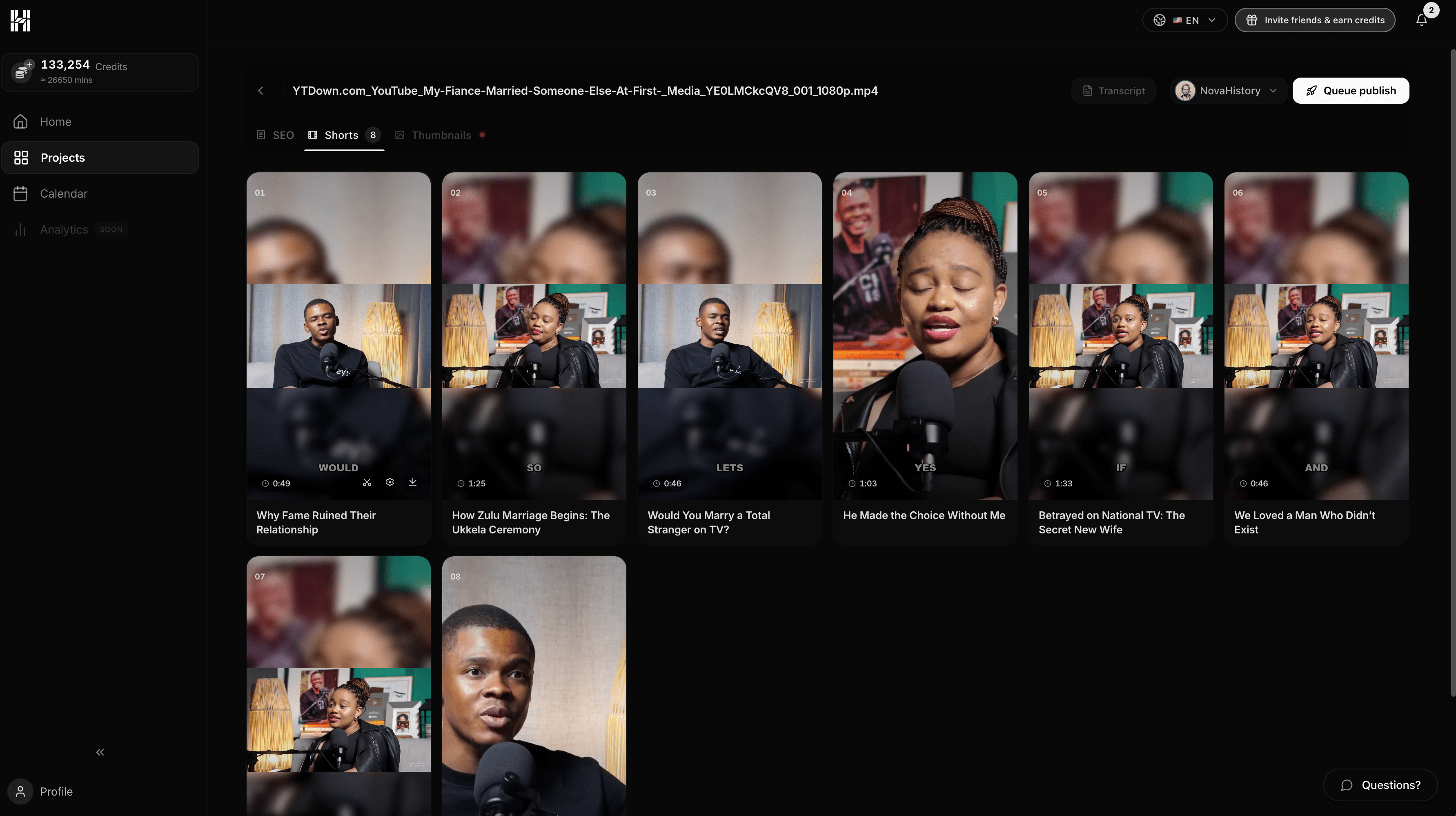
7 TikTok Video Hooks That Win Retention
Below are 7 hook frameworks designed for TikTok video hooks that improve watch time and keep people from swiping in the first 3 seconds. Each framework is battle-tested across multiple niches and comes with ready-to-use script templates you can adapt to your specific content immediately.
- The "Shock-to-Logic" Pattern Interrupt
Best for: Education, marketing, fitness, productivity, and any niche where you can challenge a common assumption.
Why it works: The brain notices "something off" or contradictory and instinctively wants the explanation to resolve the cognitive dissonance. This creates an information gap the viewer must close.
Script templates: "Stop doing X. It's the reason you're getting Y. Here's what to do instead." / "This sounds completely wrong, but it's actually the fastest way to get [result]. Let me explain." - The "Specific Result" Promise
Best for: Tutorials, case studies, transformations, and any content where you can prove a measurable outcome.
Why it works: Specific numbers and timeframes feel trustworthy and concrete. Vague promises get ignored, but specific claims demand verification.
Script templates: "I got [X-result] in [X-time] by doing this [X] simple action. Here's exactly how." / "Steal my 3-step method to [result]. Step one starts now." - The "Open Loop" Cliffhanger
Best for: Storytelling, reviews, makeovers, experiments, and any content with a reveal or transformation.
Why it works: People hate unfinished loops — the Zeigarnik effect means our brains hold onto incomplete information until it's resolved. Start something and viewers have to finish it.
Script templates: "I almost made this mistake… I'll show you why in 10 seconds. Don't scroll past this." / "Wait for the last part — this is where everyone gets it wrong and then wonders why it didn't work." - The "Hot Take" Contrarian Frame
Best for: Opinion-led niches, marketing hot takes, creator economy, and any space with strong established norms.
Why it works: Disagreement creates watch time. People who agree want validation, and people who disagree want to argue — both groups stay to watch the full video.
Script templates: "Unpopular opinion: [common advice everyone gives] is actually holding you back. Here's why." / "Most people do [X]. That's exactly why they never get [Y]. Try this instead." - The "POV / Relatable Pain" Mirror
Best for: Lifestyle, career advice, creator struggles, parenting, and any niche with shared pain points.
Why it works: Identity hooks make viewers feel "this was made for me." When someone recognizes their own struggle, they feel understood and stay to hear the solution.
Script templates: "POV: You post content every single day… and your account still isn't growing. I've been there." / "If you've ever felt [specific pain], here's exactly what I did to fix it. This worked when nothing else did." - The "Speed-Run Tutorial"
Best for: How-to content, recipes, editing tutorials, life hacks, and quick productivity tips.
Why it works: Instant value delivery reduces swipe risk. When viewers see they'll get the answer fast, they commit to staying because the time investment is low and the payoff is immediate.
Script templates: "Here's the fastest way to [task] — watch this. I'll show you in under 30 seconds." / "Do this in 10 seconds to completely fix [common problem]. Ready? Let's go." - The "Proof First" Receipt Hook
Best for: Marketing, ecom, growth, finance, and any niche where data and results build credibility.
Why it works: Viewers believe what they see with their own eyes far more than what you claim. Showing real proof upfront removes skepticism and builds immediate trust.
Script template: (Show analytics or a graph) "This retention curve is exactly why hooks matter more than content in 2026. Look at the drop-off."
Visual Triggers That Force the Pause
Editing Moves: Cuts, Zooms, Captions, B-Roll
A strong hook is rarely "just words." You need to pair your script with visual techniques that grab the eye before the brain has time to decide to swipe. Use these early in every video:
- Hard cut at 0.0s: — No fade-in, no logo intro, no countdown. The video starts immediately at full energy with zero dead frames.
- Fast motion: — Hand enters frame, quick reveal, sudden zoom, or object thrown into shot. Any sudden visual movement interrupts the scrolling reflex.
- Before/after split screen: — Instant context. The viewer understands the transformation or comparison without needing any explanation.
- Big on-screen headline: — 5-8 words max, bold font, high contrast. Place it in the center of the frame where the eye naturally lands first.
On-Screen Text Rules for 2026
- Put the main promise in on-screen text by 0.5 seconds — before you even finish your first sentence.
- Use one idea per line with clear line breaks. Don't cram multiple thoughts into a single text block.
- Keep text in the "safe area" — avoid the bottom 15% where TikTok's UI buttons overlay your video, and avoid the top where the username and caption appear.
AI Subtitles That Boost Watch Time
AI subtitles can significantly improve retention when they follow these three rules:
- Fast: — No perceptible lag between voice and text. If the text trails behind the speech, viewers get frustrated and leave.
- Chunked: — Short phrases of 2-5 words per frame for easy eye scanning. Avoid long sentences that require the viewer to read instead of watch.
- Emphasis-based: — Bold or highlighted key words to keep eyes glued to the screen and emphasize the most important parts of your message.
TikTok SEO 2026: Make Your Hook Searchable
- First spoken sentence: — Must include your main topic keyword. TikTok transcribes audio and uses it for search ranking, so your first sentence is metadata as much as it is a hook.
- First spoken sentence: — Must include your main topic keyword. TikTok transcribes audio and uses it for search ranking, so your first sentence is metadata as much as it is a hook.
- Captions: — Keep them short, punchy, and keyword-rich. TikTok indexes caption text for search, so include the primary keyword naturally in the first line.
- Hashtags: — Use 2-5 highly relevant tags — mix one broad category tag with one or two specific niche tags for maximum discoverability without looking spammy.
Mini Checklist for Every Upload
- Does the very first frame visually communicate what this video is about — no audio required?
- Is the core promise or question clearly stated by second 1 — before the viewer has time to think about swiping?
- Is the full topic and niche obvious by second 3 — so the right audience self-selects into watching?
- Did you include readable captions with chunked phrases and emphasized keywords for sound-off viewers?
Deep Dive: Anatomy of a High-Retention Hook
Understanding the theory behind hooks is useful for strategy, but most creators need a practical, frame-by-frame framework they can apply to every single video they produce. This deep dive breaks down exactly what should happen at each millisecond interval of your opening sequence, so you can audit your own content and identify exactly where retention is leaking.
Frame-by-Frame Breakdown of a Winning Hook
Frame 0 (0.0s) — The Thumbnail Moment
Before anyone watches a single frame of movement, TikTok shows a still thumbnail in the feed. This single frame is your first impression. Use high-contrast visuals, bold and readable text overlay, and an expressive face with clear emotion. The thumbnail needs to communicate the topic at a glance because it determines whether someone even lands on your video page.
Frames 1-15 (0.0-0.5s) — The Visual Grab
In the first half-second, the viewer decides whether to keep watching or swipe past. Something must be visually moving, changing, or surprising in this window — a hand entering frame, a bold text reveal, a dramatic cut, or an unexpected visual. Static frames are death at 0.0s. The brain is wired to notice change, so use that instinct to interrupt the scroll.
Frames 15-45 (0.5-1.5s) — The Verbal Promise
Once you have their eyes through visual movement, you need to give their brain a compelling reason to stay. This is where you deliver one clear, concise sentence that makes a promise, creates a curiosity gap, or states a specific problem the viewer relates to. No filler, no warm-up — the verbal hook lands here or not at all.
Frames 45-90 (1.5-3.0s) — The Context Lock
Now the viewer knows something interesting is happening. The next 1.5 seconds lock in the context: who this content is specifically for, what exact outcome they will get, and why they should trust you to deliver it. This is where you answer the unspoken question: "Is this for me?" If the answer is yes, they settle in for the rest of the video.
Frames 90-180 (3.0-6.0s) — The Delivery Start
If you have held the viewer past the 3-second mark, congratulations — the algorithm has already registered a strong positive retention signal, and your video has passed the first gate. Now begin delivering the core content immediately. Do not waste this momentum with more setup, more context, or more throat-clearing. Deliver the value you promised in the hook, starting right now.
How to Test Hooks and Iterate for Better Retention
Creating a great hook is part art, part science. The art comes from creativity and niche knowledge, but the science part is fully testable and improvable through systematic experimentation. If you treat hook creation as an ongoing optimization process rather than a one-time guess, your retention metrics will steadily improve over time.
Test One Variable at a Time
When testing hooks, change only one element between versions — either the visual opening, the verbal script, or the on-screen text. If you change multiple things at once, you won't know which change caused the difference in performance. Document each test result in a simple spreadsheet so you can build a personal knowledge base of what works for your specific audience.
Key Metrics to Track
Focus on these four metrics: 1-second view rate (how many people stay past the first frame), 3-second view rate (how many commit to the premise), average watch time (overall retention depth), and completion rate (how many watch to the end). Your hook primarily affects the 1-second and 3-second rates — if those are strong but overall watch time is weak, the problem is in your content delivery, not your opening.
Batch Testing Method
Create 3-5 versions of a hook for the same piece of content using different hook frameworks. Post one version per day at the same time, then compare the retention curves in TikTok analytics after 24 hours each. The version with the strongest 1s and 3s retention is your winner — use that framework as your default for similar content going forward.
Using AI to Generate Hook Variations at Scale
HypeNest's AI can analyze your long-form video and identify moments with the strongest hook potential, generating multiple variations for each clip in seconds. Instead of manually rewatching and recutting the same footage to test different openings, the AI produces several hook variations from the same raw material so you can A/B test them without the editing overhead.
Understanding and Fixing the TikTok Retention Curve
Every TikTok video generates a retention curve in your analytics — a line graph showing what percentage of viewers are still watching at each second. This curve is your most honest feedback tool. Here are the most common patterns and what each one reveals about your hook and content quality.
Pattern 1: Sharp Drop in the First Second
This means your very first frame is not compelling enough. The visual trigger is missing, weak, or confusing. Fix: strengthen your opening frame with higher contrast imagery, bolder text, more expressive body language, or a movement-based opening. Test adding a hard cut instead of a fade-in and see if the curve improves.
Pattern 2: Strong Start, Drop at 3-5 Seconds
Your hook successfully grabbed initial attention, but the content that followed didn't deliver on the promise. Viewers felt misled or bored once they understood what the video was actually about. Fix: make sure your content delivers the hook promise within the first few seconds after the 3-second mark. The transition from hook to body should be seamless, not a letdown.
Pattern 3: Gradual Decline Throughout
Viewers are leaving at a slow but steady rate across the whole video duration. This typically means the content lacks visual variety or pacing variation. Fix: add more cuts, b-roll, on-screen text changes, and tonal shifts throughout the video. Break your content into smaller, digestible segments with mini-hooks at each transition point to re-engage drifting viewers.
Pattern 4: Spike at the End
More viewers are watching the very end of the video than the middle section, which is unusual and indicates that something at the end is driving rewatches or re-engagement. This often happens when a compelling reveal, conclusion, or call-to-action pulls people back. Capitalize on this by making your ending even more impactful — consider adding a teaser for the next video or a rewatch-worthy visual payoff.
Pattern 5: Flat Line (High Retention)
This is the ideal retention pattern — your hook was perfectly targeted and the content was engaging enough to keep nearly every viewer through the entire duration. When you see this pattern, document exactly what you did: the hook framework used, the visual triggers, the pacing, and the topic. Then replicate that structure for future videos. Build a swipe file of your flat-line winners and reverse-engineer them.
Adapting Hooks for YouTube Shorts and Instagram Reels
While these hook principles are optimized specifically for the TikTok algorithm's unique micro-retention mechanics, most apply directly to YouTube Shorts and Instagram Reels as well — with small but important platform-specific adjustments. Learning to adapt your hooks across platforms lets you get more mileage from every piece of content you create.
YouTube Shorts Hook Adaptations
YouTube Shorts allows a slightly longer attention window than TikTok because the platform attracts more search-driven and browse-driven viewers who expect to invest time in content. You have about 1-2 seconds to grab attention instead of TikTok's 0.5-1 second window. Lead with a keyword-rich spoken sentence since YouTube heavily weights audio transcription for search discovery.
Instagram Reels Hook Adaptations
Visual movement is even more critical on Instagram because the feed mixes static photos with video content — your reel needs to immediately distinguish itself as a video. Use faster cuts and more dramatic visual transitions. Instagram's algorithm also places more weight on saves and shares than TikTok does, so include a "save this for later" moment early in your hook to encourage that behavior.
Cross-Platform Hook Testing Strategy
Create your hook optimized for TikTok first (the strictest attention window), then adapt for YouTube Shorts by extending the setup slightly and adding more SEO keywords to your spoken intro, and adapt for Instagram Reels by increasing visual pace and adding a save-worthy element. This tiered approach ensures your hook survives the most demanding platform and only improves from there.
Measuring Hook Performance: Retention Curve Analysis
Your TikTok retention graph is the most honest diagnostic tool you have as a creator — and most people barely glance at it. Every video you post generates a line graph in TikTok Analytics showing the exact percentage of viewers still watching at each second. Reading this graph correctly lets you pinpoint whether your hook is failing, whether your content body is the problem, or whether both need work. Skipping this step is like editing blindly, hoping something changes without knowing what broke in the first place.
Step 1: Open the Retention Graph
In TikTok Analytics, tap any video, scroll to the "Audience Insights" section, and open the viewer retention graph. You'll see a line that starts at 100% and curves downward. The shape of that curve — how steep it drops, where it plateaus, and where it spikes — tells you everything you need to know about how your hook is performing.
Step 2: Identify Your Key Drop-Off Points
Focus on four critical moments: the 1-second mark, the 3-second mark, the midpoint of your video, and the final 10% of the video. A steep drop before 1 second means your first frame failed. A drop at exactly 3 seconds means your verbal hook didn't deliver on the visual promise. A gradual slide after the midpoint means your content delivery is losing energy. Each drop-off point is a specific, actionable fix — not a vague problem.
Step 3: Compare Two Videos Side by Side
Pull the retention curves for two videos on the same topic: one that performed well and one that underperformed. Align them in a spreadsheet and compare where the curves diverge. If both drop at 3 seconds, the hook framework is the culprit. If only the underperforming video drops at 3 seconds but the strong video holds, the verbal delivery is different. This comparison method isolates whether your hook or your content body is the variable that needs work.
Step 4: Diagnose Hook vs. Content Body
The 1-second and 3-second retention rates are your hook scores. If these are strong (above 70% and 50% respectively) but average watch time is low, your hook is working but your content body isn't delivering on the promise. If both the 1s and 3s rates are weak, the hook itself is the problem. Run this diagnosis on every video before starting your next editing session — it turns vague "this video didn't work" feelings into specific technical fixes you can implement immediately.
Most creators spend their editing time improving production quality. Retention curve analysis tells you to spend that time improving structural decisions — the ones that actually determine whether viewers stay or go.
Adapting Hooks for YouTube Shorts and Instagram Reels
TikTok hooks are designed for the most unforgiving attention window in short-form video — which means they translate well to other platforms, but need small adjustments to match each platform's unique viewer psychology. Understanding these platform-specific rules lets you repurpose content intelligently without just copy-pasting the same hook everywhere and wondering why performance varies.
YouTube Shorts: Intent-Driven Viewers
YouTube Shorts viewers typically arrive with higher intent than TikTok scrollers — they're often searching for something specific or browsing related videos after watching something they chose. This means your verbal hook can afford slightly more setup: instead of a 0.5-second visual blitz, you have a 1-2 second window before viewers commit to a decision. Lead with a keyword-rich spoken sentence in the first 1.5 seconds because YouTube transcribes audio for search indexing, and that first sentence is the single strongest SEO signal in a Short.
Instagram Reels: Aesthetic and Sound Lead
Instagram's feed is a mix of static posts, carousels, and Reels — so your video needs to immediately signal that it's moving content worth pausing for. Use faster cuts in the first second than you would on TikTok, since Reels viewers are accustomed to highly produced aesthetic content. Audio also plays a stronger role on Instagram: using trending sounds or a punchy audio hook within the first half-second significantly boosts the algorithm's push in the Explore feed. If your TikTok hook relies heavily on text and spoken word, add a visual movement element before the text appears on Reels.
Visual Hook Differences by Platform
On TikTok, extreme close-ups and talking-head openings perform well because the algorithm rewards authenticity. On YouTube Shorts, a result-first visual (showing the end state before explaining how) drives stronger click-through from the feed thumbnail. On Instagram Reels, aesthetic transitions and color-graded first frames signal production quality, which triggers the saves behavior that Instagram's algorithm heavily rewards. Adapt your visual opening for each platform instead of using the same first frame everywhere.
A/B Testing the Same Hook Across Platforms
Post the same core hook with platform-specific tweaks on all three platforms within 24 hours of each other. Track 3-second view rate on TikTok, click-through rate on YouTube Shorts, and save rate on Instagram Reels. The platform where the hook performs worst tells you which element is platform-specific versus universally effective. Use those findings to update your hook framework defaults for each platform going forward.
Building a Hook Testing System
The difference between creators who consistently grow and those who plateau isn't talent — it's infrastructure. A hook testing system turns creative experimentation from guesswork into a repeatable process, and once it's running, you'll know within 48 hours whether a hook is a winner or needs to be retired.
Build a Hook Variation Bank
Before publishing any video, write at least 3 hook variations using different frameworks from the 7 types above. Variation 1 uses the Shock-to-Logic pattern, Variation 2 uses a Specific Result promise, and Variation 3 uses an Open Loop cliffhanger. This isn't extra work — it's a 10-minute writing exercise that gives you three testable assets from a single piece of content. Store all variations in a Google Sheet or Notion database tagged by framework type, niche topic, and performance outcome so you can build a pattern library over time.
The 2-Week Hook Testing Cycle
Week 1: Post one variation per day, using the same core content but different hooks. Don't change the content body, music, or visual style — isolate the hook as the single variable. After each video reaches 200+ views, log the 1s and 3s retention rates in your tracking spreadsheet. Week 2: Review your results across the videos from Week 1. Identify the top-performing hook framework for that specific topic and audience. Use that framework as your default template for the next batch of similar content — then repeat the cycle with a new topic and a new set of 3 variations.
Track Which Hook Types Win in Your Niche
Not all hook types perform equally across niches. Finance content tends to respond best to the Proof First and Specific Result frameworks because credibility is the primary purchase signal. Lifestyle content performs better with POV and Relatable Pain hooks because emotional resonance drives engagement in that space. Spend 4-6 weeks tracking results by hook type across your content categories, and you'll build a clear picture of your personal hook formula — the combination of framework and visual trigger that consistently outperforms in your specific niche.
Build a Hook Swipe File
Every time you scroll TikTok, YouTube Shorts, or Reels and something stops your scroll, screenshot it and save it to a dedicated folder labeled by hook type. After 2 weeks you'll have 50-100 real-world examples of working hooks in your niche or adjacent niches. When you're stuck creating your own hooks, open your swipe file and find a pattern that worked for someone else, then adapt the structure to your own topic. A hook swipe file is the fastest way to break creative block and avoid reinventing the same patterns over and over.
Using AI to Generate 10 Hook Variations in Minutes
Feed your video transcript or a one-paragraph summary of your content into HypeNest's AI hook generator. Specify the hook framework type and your target niche, and the AI will produce 10 hook variations based on the same core idea in under a minute. Rather than choosing one and committing, pick your top 3 variations and schedule them across 3 consecutive posting days. This workflow eliminates creative block entirely — you'll never stare at a blank script wondering how to start again, and each new test adds another data point to your niche hook formula.
FAQ: TikTok Algorithm 2026
What is the most important signal for TikTok reach in 2026?
Retention behavior in the first 3 seconds is the primary lever for reach distribution. The algorithm tests your video on a small pool, and if retention drops sharply early, expansion stops. A strong hook is the single highest-leverage change you can make.
How long should my hook actually be?
Aim for a complete hook stack (visual trigger + verbal promise + context lock) within 1 to 3 seconds total. The visual hits at 0.0s, the spoken hook by 1.5s, and the context setup by 3.0s. If your hook takes longer than 3 seconds to land, your retention is already dropping.
Can HypeNest replace my manual video editing workflow?
HypeNest helps draft short vertical clips with captions from a long source video so you spend less time scrubbing timelines. You still choose hooks, review every clip, and publish only when ready. Direct publish is live for YouTube and TikTok. Free to start — no credit card; paid features may come later with notice. It does not guarantee views or “virality.”
Conclusion
Practice beats theory: pick one hook framework, post, and read your retention graph. When you want faster packaging, upload a long video to HypeNest’s free AI clip generator, review candidates, and publish to YouTube or TikTok yourself. Free to start (no card) — not a paid trial pitch. No fixed clip counts and no algorithm guarantees — just a review-first workflow.
Try the free clip workflow
Upload one long video. Get clip candidates with captions to review. Publish to YouTube and TikTok when you approve — free to start, no credit card.