
YouTube Shorts SEO Checklist for 2026
Use this practical YouTube Shorts SEO checklist to improve titles, descriptions, tags, thumbnails, and publishing consistency in one repeatable workflow.
Many creators still upload Shorts like they are invisible to search. They title fast, skip the description, ignore tags, and hope distribution happens automatically. But Shorts still rely on packaging signals. Good clips do better when the platform can understand the topic, the viewer promise, and the reason the upload belongs in a search or recommendation surface.
The point of a Shorts SEO checklist is not to over-optimize every upload. It is to build a repeatable process so your metadata quality stays high enough to compound over time. The creators who publish consistently with clean packaging usually beat the creators who optimize only when they remember.
Quick Answer
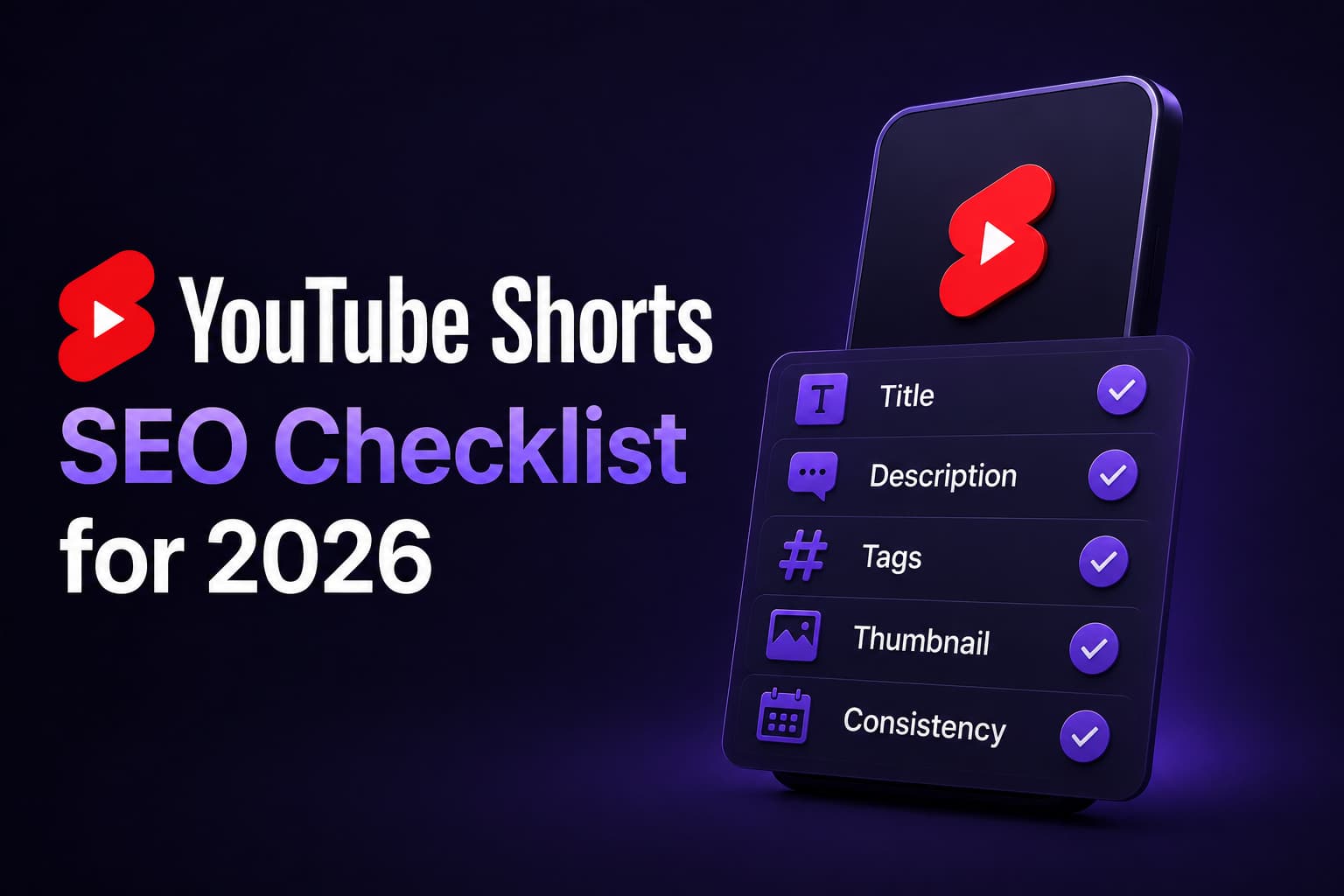
A strong Shorts SEO workflow in 2026 covers five things: a keyword-informed title, a description that adds context, a small set of relevant tags, a scroll-stopping thumbnail, and consistent publishing around topics your audience already cares about.
HypeNest makes this easier because titles, descriptions, thumbnails, and scheduling can sit in one workflow. That keeps SEO from turning into a separate cleanup task after the clip is already exported.
Use this checklist on every Short
The easiest way to improve Shorts SEO is to standardize the upload checklist instead of treating optimization as optional.
- Lead the title with the topic, problem, or exact phrase viewers would search for.
- Use the description to add supporting context, not to repeat the title word for word.
- Add a focused tag set for variants, branded terms, and supporting phrases.
- Use a thumbnail that creates visual contrast and matches the title promise.
- Publish on a repeatable cadence so the channel sends clearer consistency signals.
- Review which title patterns and topics actually earn replays, retention, and clicks.
A weekly SEO workflow that is actually sustainable
Choose the topic cluster before writing the metadata
Draft all titles in one batch
Write descriptions after the title promise is set
Review results weekly and update the playbook
The most common Shorts SEO misses
Generic titles
Empty descriptions
Overstuffed tags
Inconsistent packaging
Build a keyword research workflow for Shorts, not blog posts
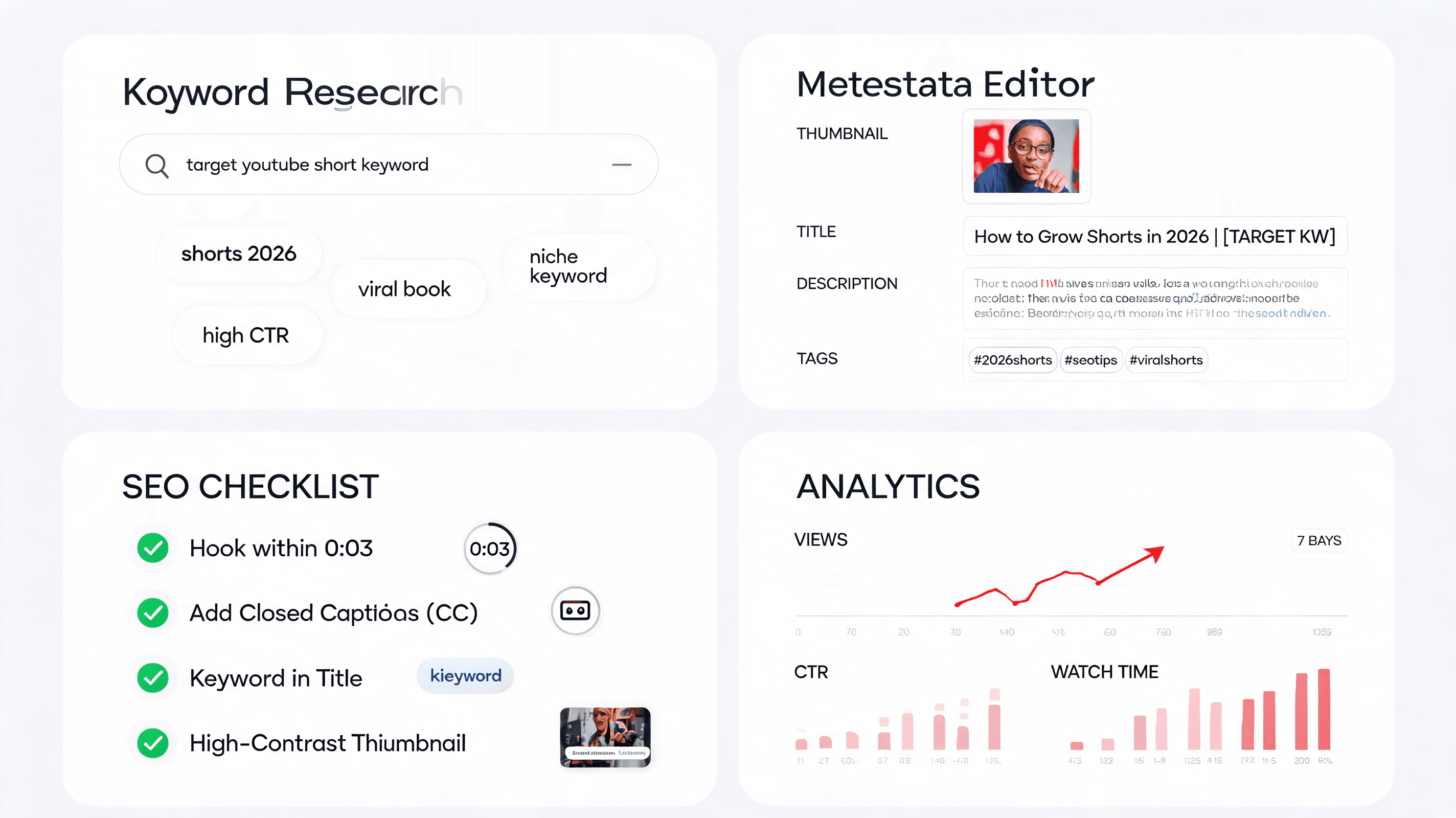
Keyword research for Shorts works best when one upload maps to one clear viewer question. YouTube can understand a broader channel theme over time, but each individual Short still needs a tight promise. If you try to target beginner advice, advanced tactics, creator news, and a product pitch in the same clip, the packaging gets muddy before the video is even published.
Use research before you script the hook. The phrase you choose changes the first line, the examples you include, the text you put on screen, and the proof you use to earn retention. That means SEO is not a cleanup task after export. It is the decision that tells you what the Short is actually about.
You also do not need an enterprise stack to do this well. YouTube search suggestions, the Shorts results page, competitor titles, viewer comments, and your own analytics usually give enough signal to pick a stronger angle than random inspiration does.
One more practical rule: keep a running split between search-led topics and feed-led topics. Search-led Shorts answer explicit questions with precise wording. Feed-led Shorts can be broader and more curiosity-driven. When you separate those buckets in your planning doc, you stop forcing vague inspiration clips into search packaging they were never built to satisfy.
Start with the exact problem a viewer would type
Expand into close variants without bloating the topic
Check live Shorts results before finalizing the angle
Choose one primary term and two support terms
Script the hook around the search intent, not after it
Save winners in a reusable keyword bank
How packaging signals work together on YouTube Shorts
YouTube does not evaluate your title in isolation. It compares the title with the first frame, the spoken hook, any on-screen text, the description, the thumbnail, the surrounding uploads on your channel, and the way viewers behave after they click. Shorts SEO improves when those signals reinforce the same topic instead of pointing in different directions.
Think of packaging as a chain rather than a checklist. A strong title cannot fully rescue an opening that hides the topic for five seconds. A polished thumbnail cannot compensate for a description stuffed with unrelated keywords. Coherence usually beats cleverness because both the viewer and the platform can classify the clip faster.
That is why isolated optimization rarely compounds. The best-performing Shorts usually feel unmistakable before the viewer even hears the full explanation. Every visible cue says the same thing, and the clip pays it off quickly.
| Item | Details |
|---|---|
| Title as the promise | The title sets the contract. It should state the topic, outcome, or mistake clearly enough that a viewer can decide in one glance whether the Short matters to them. Strong titles also help every other signal stay aligned because the description, on-screen text, and thumbnail can all echo the same promise instead of inventing their own. |
| First two seconds as confirmation | The opening frame and spoken hook confirm whether the title told the truth. If the title promises a checklist, the viewer should hear the checklist framing immediately. If the title promises a fix, the clip should surface the problem fast. This alignment matters for retention because viewers drop quickly when the first seconds feel like a different video. |
| On-screen text and captions as reinforcement | Many Shorts are watched in low-sound or no-sound environments, especially during the first scroll decision. Use text overlays and accurate captions to repeat the central idea in fewer words, not to flood the screen. When the viewer sees the same topic in the title, first frame, and captions, the message becomes easier to trust and remember. |
| Description and tags as context | Descriptions and tags are supporting signals, not the main hook. Their job is to clarify the topic, add natural language around the primary term, and help YouTube disambiguate your clip from broader lookalike content. When they stay close to the actual subject of the Short, they strengthen classification. When they chase unrelated volume, they create noise. |
| Thumbnails where they still matter | Shorts often get watched inside the feed, but thumbnails still matter on channel pages, search results, and some browse surfaces. A good thumbnail should not introduce a second concept. It should visually amplify the same idea the title already promised, using contrast, expression, and short readable text only when it adds clarity. |
| Channel clustering and viewer response | Your channel history shapes how fast YouTube understands a new upload. If you publish multiple Shorts around one topic cluster, the platform gets cleaner evidence about who should see them. Viewer behavior then acts as the feedback loop. Strong hold rate, rewatches, and satisfied comments tell YouTube that the packaging matched the content rather than overselling it. |

The SEO metrics that actually tell you what to fix
Shorts SEO measurement is not just about views from search. Search visibility, click behavior, retention, rewatches, and topic-level consistency all answer different questions. One metric tells you whether YouTube understood the packaging. Another tells you whether viewers believed the promise. A third tells you whether the clip actually delivered after the click.
This is why vanity reporting creates bad decisions. A Short can spike in the feed because of broad distribution even when the metadata is weak. Another can bring modest total views while quietly becoming one of your best search assets for a narrow topic. If you only reward total views, you end up copying the wrong patterns.
Review metrics in 7-day and 28-day windows, and compare uploads inside the same topic cluster whenever possible. That gives you a cleaner read on what changed: the subject, the packaging, the opening hook, or the actual usefulness of the clip.
- Search views by upload and by topic cluster. This is the clearest direct signal that your metadata and topic choice are matching real demand. Watch individual videos, but also track whether an entire cluster such as Shorts SEO checklist or YouTube captions tips keeps earning search traffic over time.
- Search impressions and browse impressions. If impressions exist but views do not, the packaging is likely weak or unclear. If the clip gets almost no impressions anywhere, the issue is more likely topic selection, low initial response, or a channel with limited authority in that subject.
- Click-through rate on surfaces where the title and thumbnail are visible. Shorts feed behavior does not always show the same CTR data as search or browse, so use it when available to judge whether your promise is strong enough before the viewer enters the clip.
- First three-second hold rate. This is where title truth gets tested. A good title can earn the click, but the opening must confirm the promise immediately. Sharp drop-off in the first seconds usually means the hook, first frame, or pacing is misaligned with the packaging.
- Average percentage viewed and completion rate. For short videos, these numbers tell you whether the structure keeps its promise all the way through. High completion on a targeted topic is one of the best signs that the packaging brought in the right audience rather than the widest audience.
- Rewatch rate or repeat views. Rewatches often indicate that the clip delivered a compact lesson, checklist, or example people wanted to revisit. That matters for Shorts because replay behavior is one of the clearest signals that a utility-based video created real value.
- Comments that repeat your phrasing back to you. When viewers use the same language as the title or hook in their comments, it usually means the positioning was clear. When comments show confusion about the topic, your metadata may be promising something different from the clip itself.
- Subscriber gain, profile visits, and next-video behavior. SEO should not only attract clicks; it should attract the right clicks. If a topic consistently drives qualified follow-through, it is a better long-term cluster than a random spike that brings views with no downstream interest.
- Change logs after repackaging. When you revise a title, description, thumbnail, or first-frame text, note what changed and when. Over a few months, this record becomes more useful than memory and helps you see which packaging adjustments actually improve discoverability.
- Win rate by title formula inside the same cluster. Compare checklist titles, mistake-led titles, question titles, and proof-led titles against similar topics. This keeps your conclusions grounded and helps you discover whether the channel responds better to direct utility, contrarian framing, or before-and-after language.
- Search query movement after updates. If you retitle or repackage a Short, watch whether the search terms associated with it become narrower, clearer, or more aligned with your intended topic. This helps you confirm that the platform is understanding the revised packaging instead of merely redistributing the clip to a broader but less qualified audience.
A mistake-recovery playbook for underperforming Shorts
Every Shorts channel publishes misses. The expensive mistake is not the weak upload itself; it is guessing at the cause and rewriting your whole strategy based on one result. Low impressions, poor click-through, weak retention, and zero search pickup point to different failures. If you diagnose the wrong one, the next fix is usually wasted motion.
Recovery also works best when you change one variable at a time. If you rewrite the title, swap the thumbnail, change the description, and repost a recut version all at once, you learn almost nothing. A simple playbook turns disappointing uploads into clean feedback and keeps emotion out of the process.
Some fixes belong on the live video, and some belong in the next batch. The goal is not to rescue every miss. The goal is to stop repeating the same mistake across ten future uploads.
Label the failure mode before editing anything
Fix packaging mismatch first when the idea is still sound
Rewrite the title and thumbnail as a pair when clicks are low
Recut or repost only when the opening is the real problem
Mine comments, search queries, and audience language for the next version
Log the lesson and move the insight into the next batch
HypeNest routes for SEO batching
HypeNest SEO
YouTube Keyword Generator
YouTube Tags Generator
Video Titles Generator
FAQ
Do YouTube Shorts still need descriptions in 2026?
How many tags should a Short use?
What matters more for Shorts discovery: title or thumbnail?
Can a good SEO checklist fix a weak clip?
Make Shorts SEO a weekly habit
Use HypeNest to batch titles, descriptions, tags, and planning so every Short ships with better discoverability by default.